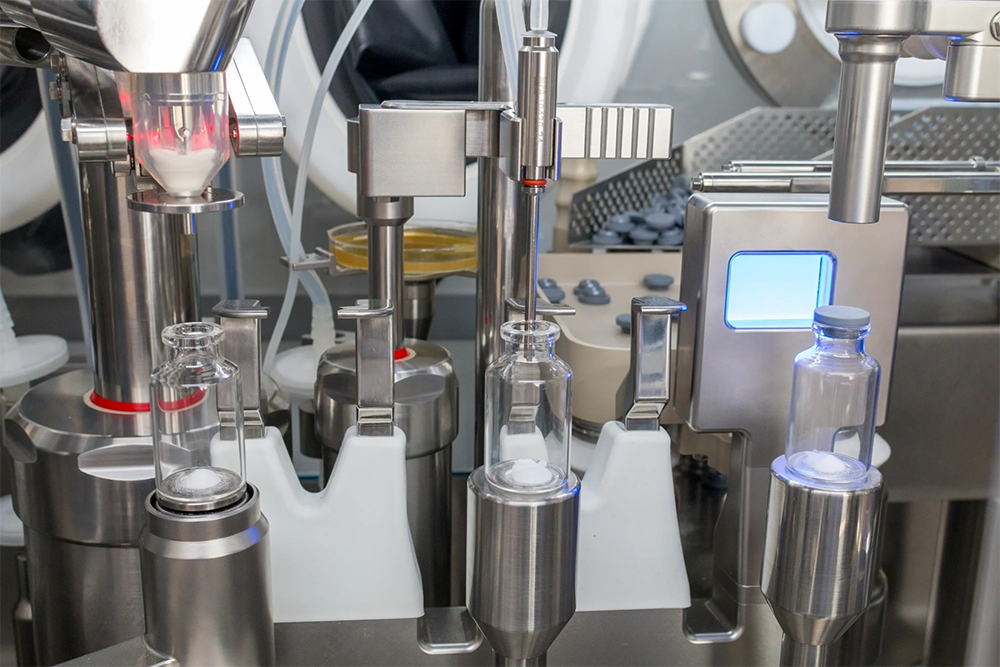
The Dual Challenge of Particle Control: How to Handle Intrinsic Product Powder Particles During Continuous Particle Monitoring
When a clinician relies on a reconstituted product from a precisely filled sterile powder vial, they do so with implicit trust. This trust is not built on any single test or terminal step. It is earned through a comprehensive, end‑to‑end Contamination Control Strategy (CCS) that spans facility design, barrier technologies, personnel, utilities, aseptic practices, container closure integrity, environmental monitoring, and aseptic process simulations (APS) also known as media fills.
Annex 1 sets rigorous requirements for contamination control in aseptic processing, mandating continuous total particle monitoring in Grade A (ISO Class 5) environments throughout all critical operations. In liquid filling, this aligns directly with environmental control, where any particle excursion is interpreted as a deviation linked to process, equipment, or personnel. In powder filling, however, manufacturers encounter an added complexity: they must comply with real-time environmental monitoring expectations while
also managing the intrinsic particles naturally generated by the sterile powder itself during dosing or transferring process.
This paper presents a clear, practical way to think about this challenge. Sterile powder filling creates intrinsic, product‑related particles that are expected and unavoidable. Continuous particle monitoring (CPM), however, is designed to detect extrinsic contamination. The key is to design your monitoring strategy so that it distinguishes between the two and remains compliant with Annex 1 and FDA expectations.
1. Understanding the Regulatory Expectation.
Continuous Particle Monitoring: Annex 1 requires uninterrupted total particle monitoring at ≥0.5 µm and ≥5 µm throughout all aseptic operations where product is exposed. Monitoring systems must 1) operate continuously during setup, routine operation, and any interventions; 2) trigger alarms based on defined alert and action levels; 3) provide data suitable for trending and rapid response and 4) function without disrupting unidirectional first air or compromising the integrity of the critical zone. In sterile liquid operations, particle counters primarily detect environmental contamination, so any spike in particle levels is generally interpreted as a true process, equipment, or personnel deviation requiring investigation.
Intrinsic Particle Behavior in Powder Filling: Unlike liquid operations, sterile powders could inherently generate fine airborne particulates during handling and filling. These particles may result from 1) powder agitation, dosing mechanisms, or screw feeds; 2) turbulence introduced during transfers; 3) static charges on product or components or 4) stoppering and capping movements over powder-filled vials. Because these particles originate from the product itself, they do not represent environmental contamination. However, particle counters cannot differentiate product-generated plumes from true environmental particulate events. Consequently, continuous monitoring systems frequently detect predictable count increases during 1) dosing cycles; 2) transient plumes caused by vial movement or equipment stops and starts and 3) non-actionable spikes that resemble environmental excursions. This overlap complicates interpretation of monitoring data and increases the burden on deviation management, trending, and justification within the CCS.
Regulators expect that environmental monitoring (EM) and CPM reflect the true state of control of the aseptic environment, not the product itself. Annex 1 emphasizes that EM is part of the CCS and must be designed to minimize risk of microbial and particle contamination.
However, powder filling is recognized as a special case: the act of filling creates dense dust plumes that can overwhelm particle counters. This is explicitly discussed in some industry guidance and technical literatures.
2. Why Intrinsic Powder Particles Are a Problem for CPM.
Powder filling is recognized as a special case for CPM. The act of filling creates dense dust plumes that can overwhelm particle counters, resulting in several major challenges:
- Powder plumes can saturate particle counters, producing meaningless spikes.
- Counters may require long purge cycles before returning to normal function.
- CPM alarms may trigger falsely, masking real contamination events.
- Data may become non‑actionable, undermining the contamination control strategy.
Although sterile powders inherently generate particulate matter, Annex 1 still requires full Grade A protection with continuous monitoring. As a result, manufacturers must 1) demonstrate that intrinsic particle behavior is well-characterized, consistent, and controlled; 2) establish scientifically justified alert and action levels that account for product-related background particulate levels; 3) ensure isolator or RABS airflow patterns minimize unnecessary powder plume formation and 4) design equipment and processes that reduce particle liberation wherever feasible.
3. Accepted Approaches to Compliance.
A. Risk‑Based Monitoring Locations
Place continuous particle counters outside the direct powder plume, focusing on areas where extrinsic contamination would realistically enter the process.
- This aligns with guidance on selecting monitoring locations for fill-finish operations.
- Counters should monitor the environment, not the product stream.
B. Barrier Technology (RABS/Isolators) to Separate Product Dust from Monitoring Zones.
Powder filling inside RABS or isolators is common.
- The enclosure contains dust plumes.
- Particle counters can be positioned in “clean” zones where extrinsic contamination would appear.
- This is consistent with powder‑filling monitoring strategies described in technical literature.
C. Event‑Based or Intermittent Monitoring Instead of True Continuous Monitoring
For powder filling steps that inherently generate dust plumes:
- Use intermittent sampling or process‑interruption sampling (e.g., between fills).
- Document scientifically why continuous sampling during active filling is not meaningful.
- Regulators accept justified exceptions when continuous monitoring produces invalid data.
D. Specialized Particle Monitoring Technology
Some systems are designed to avoid saturation and eliminate purge cycles during powder filling. These systems can differentiate between high‑density product dust and environmental contamination.
E. Intrinsic vs. Extrinsic Particle Profiles in Your CCS
Your contamination control strategy should explicitly:
- Identify intrinsic product particles as expected.
- Define how they differ from extrinsic contamination (size distribution, timing, location).
- Establish alarm/action limits that exclude intrinsic events.
- Justify scientifically why certain CPM data during filling is excluded or interpreted differently.
F. Process Understanding and Trending
The best practice of continuous microbiological and particle monitoring emphasizes using data to reduce interventions and improve process understanding.
- Trend particle levels before and after filling to demonstrate environmental control.
- Show that spikes correlate with product dust, not contamination.
4. What Regulators Expect You to Document
A compliant approach requires strong documentation requirements:
| Requirement | What You Must Demonstrate |
|---|---|
| Scientific justification | Why CPM during active powder filling is not meaningful or must be modified. |
| Risk assessment | How intrinsic particles are distinguished from contamination. |
| Monitoring strategy | Placement, timing, and rationale for particle counters. |
| Data interpretation rules | How intrinsic spikes are excluded or contextualized. |
| CCS integration | How the strategy fits into your overall contamination control plan. |
The above approach aligns with Annex 1’s emphasis on CCS‑driven monitoring.
5. Practical, Industry‑Aligned Strategy (Summary)
During active powder filling:
- Avoid placing counters directly in the powder plume.
- Use RABS/isolators to contain dust.
- Use intermittent or event‑based monitoring if continuous data is invalid.
- Use specialized counters if continuous monitoring is required.
Before and after filling:
- Use CPM to confirm environmental control.
- Trend data to show stability and detect extrinsic contamination.
In your CCS:
- Clearly define intrinsic particles and justify your monitoring approach.
- Provide risk‑based rationale for counter placement and alarm limits.