Precision Aseptic Powder Filling: Fully Automated Solutions in Compliance with Annex 1
Imagine threading a needle while standing in a wind tunnel. The thread is delicate, the needle’s eye is tiny, and the wind is constantly trying to blow everything off course. Now, replace the needle with a life-saving medicine in sterile powder form, the thread with a presterilized vial, and the wind with unidirectional airflow required to keep potential contaminants away.
This is the daily reality of aseptic powder filling. While it sounds simple, filling sterile powders is a battle overcoming powder variation, potential contamination, and regulatory challenges.
Why not make every medicine a liquid? Because some pharmaceutical active ingredients (API) are not stable in liquid form during storage. Keeping them as powder is essential for four major advantages:
- Stability: Improved stability for the drugs that are prone to degrade in aqueous solutions.
- Simplicity: No formulation development is required, eliminating the need for additional excipients.
- Microbial Control: Prevents microbial growth by eliminating free water, which microbes need to thrive.
- Logistics: Liquids often need costly refrigeration during transport; powders usually do not, making shipping easier and cheaper.
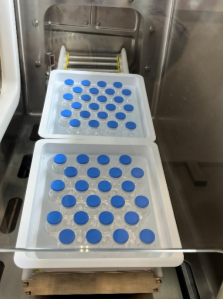
In addition to the advantages noted above, aseptic powder filling may be the only viable option because:
- Terminal sterilization of finished vials is not feasible.
- Lyophilization of liquid-filled vials is either impractical or prohibitively expensive.
Compared with liquid dosing, powder filling has its own distinct characteristics, and demands specialized expertise and experience to develop effective, creative solutions.
Challenge #1: The Complex Behavior of Powders
Powders present unique handling difficulties compared to liquids due to the absence of surface tension and cohesive flow properties. Unlike liquids, which exhibit predictable laminar flow, powders consist of discrete particles that can become airborne with minimal disturbance, increasing contamination risk in aseptic environments. Several critical material characteristics contribute to this complexity:
- Flowability: Powder flow is highly dependent on particle morphology, size distribution, and interparticle cohesion, and handling environment. Poor flowability can lead to clumping, bridging, and rat-holing within hoppers, resulting in inconsistent dosing and process interruptions.
- Electrostatic Charge Accumulation: Electrostatic effects during handling can generate static charges, causing particle adhesion to equipment surfaces or repulsion between particles. This disrupts mass flow and compromises dosing accuracy.
- Hygroscopicity: Many pharmaceutical powders exhibit moisture sensitivity. Ambient humidity can induce agglomeration or caking, obstructing filling mechanisms, and degrading product quality.
- Airflow Interaction: ISO 5 environments require unidirectional HEPA-filtered airflow. While essential for sterility, this airflow can displace low-density powders, creating dosing variability and operational challenges, a paradox inherent to aseptic powder filling. Airflow can also cause instability in the load cell used for dosing weight measurement.
Understanding these powder-specific behaviors is critical before addressing the stringent requirements of the aseptic processing environment in which they must be processed.
Challenge #2: Contamination Control - Process Automation
In aseptic processing, the greatest source of potential contamination is the human operator. Our bodies continuously shed particles and microorganisms, making strict contamination controls is essential. Together, process automation and isolator technology provide a high level of sterility assurance:
- Automation: Process automation significantly reduces the need for operator intervention throughout the aseptic process and minimizes opportunities for contamination. Unlike liquid fill/finish, where advanced, high‑efficiency manufacturing technologies are well established, complete solutions for aseptic powder processing and fill/finish remain limited. Automated systems often require custom engineering tailored to the specific product or process needs.
- Isolation: Modern isolator technology creates a physical barrier between operators and aseptic process. This further reduces contamination risk. However, the use of isolator technology in aseptic powder processing remains uncommon at present.
Challenge #3: Achieving Milligram-Level Precision in Powder Filling
Accurate dosing of sterile powders is significantly more complex than liquid filling. While liquids exhibit predictable flow behavior, powders lack cohesion and can behave erratically. For powder dosing at low milligram level, such as 10 mg, control consistent dosing accurate and precision remains as a major challenge.
To overcome the above challenges, Dalton collaborated with 3P Innovation and implemented a fully automated fill/finish system, RoboFIL™, for aseptic powder dosing.
The system integrates 3P’s advanced engineering with Dalton’s expertise in aseptic powder processing, resulting in the following solutions:
- Real-Time Gravimetric Control: Fill2Weight uses high-speed weigh cells to deliver precise, weight-based dosing, eliminating variability caused by bulk density fluctuations.
- Optimized Powder Handling: Proprietary design features mitigate bridging, rat-holing, and electrostatic adhesion, ensuring smooth, controlled powder flow.
- Integrated Sterility Solutions: Systems are engineered for isolator integration and automation, reducing human intervention and contamination risk while maintaining compliance with global regulatory standards..
- Regulatory Compliance: The system is designed and operated in full alignment with Annex 1 requirements for aseptic processing.
- Scalable and Validated: Dalton provides full validation support, ensuring regulatory compliance and robust performance from clinical trials to commercial-scale production.
By combining innovative technology with decades of aseptic processing expertise, Dalton enables pharmaceutical manufacturers to overcome the inherent challenges of sterile powder filling, delivering accuracy, sterility, and efficiency where it matters most.
Executive Summary & Conclusion
Aseptic powder filling is among the most complex operations in pharmaceutical manufacturing. Unlike liquids, powders exhibit unpredictable behavior, lack surface tension, prone to electrostatic charge, and sensitive to humidity, making precise dosing and contamination control challenging. These difficulties are compounded in aseptic processing environments, where unidirectional airflow, essential for compliance, can disrupt powder flow and dosing accuracy and consistency.
Three critical challenges defined this process, each addressed through targeted solutions:
- Powder Behavior: Introduced flexible dosing assemblies, developed by 3P Innovation, to accommodate variability in powder flowability
- Contamination Control: Implemented manufacturing automation and isolator technology to minimize opportunities for potential contamination.
- Milligram-Level Precision: Applied 3P’s proprietary Fill2Weight powder‑dosing technology to achieve a high level of accuracy and precision at low‑milligram fill weights.